In 2026, communication professionals are findings themselves at the intersection of insularity, uncertainty, and accelerated technological change. Trust continues to erode, but in different ways: political polarization has hardened into insularity, workers and consumers are demanding greater accountability, and organizations face a “permacrisis” where geopolitical, economic, technological, and societal pressures overlap rather than unfold in sequence.
In the face of such complexity, the role of the communicator is expanding. Trend reports show communicators are being firmly placed in a strategic role, helping organizations interpret risk, navigate ambiguity, and reconnect fragmented audiences. Communicators are being called on to broker trust, guide leaders through strategic silence and responsible transparency, and to model civil discourse.
The conversation around AI is maturing, too. We’re moving beyond experimentation toward rethinking workflows, governance, and safeguards. Organizations aren’t asking if they should adopt AI, but how to do so ethically and in tandem with human guidance. At the same time, employees are signaling a desire for meaning, stability, and credible pathways for growth. Communicators are playing a central role in clarifying expectations, reducing noise, and reinforcing culture in the face of change.
Across all reports, one theme is clear: communication is not merely a function; it is a strategic capability that determines whether organizations can maintain trust, safeguard reputation, and meaningfully engage their stakeholders.
The IABC Professional Development and Content Committee is proud to present its third annual State of Comms report. Developed by communication professionals for communication professionals, the review offers key insights from leading industry research to help guide communicators in a year defined by complexity, interdependence, and opportunity.
2026 Edelman Trust Barometer: Trust Amid Insularity
Source: Edelman
Submitted by: Kelli Cargile Cook
A Glance at the Report
In its 26th annual global survey, the 2026 Edelman Trust Barometer draws on responses from nearly 34,000 people across 28 countries to assess the state of trust worldwide. The findings show continued erosion since 2023, when Edelman first identified rising polarization, and 2025, when that polarization hardened into what the firm called a “crisis of grievance.”
This year’s report argues that economic anxiety, fears of job loss, concerns about AI, and deepening political divides have fueled a turn toward insularity — a growing distrust of those individuals and institutions perceived as different.
As Richard Edelman describes it, society is shifting “from we to me.” To counter this inward turn, the report introduces the concept of trust brokering: deliberate practices aimed at rebuilding trust across differences and restoring a shared sense of mutual responsibility.
Key Takeaways for Communicators
For business communicators, trust brokering is not a peripheral task — it is central to the profession’s strategic value. Trust brokers serve as translators and bridge builders, helping stakeholders understand one another’s needs, constraints, and realities. The report highlights practical strategies: avoiding polarizing rhetoric, modeling civil discourse, and ensuring fair representation of diverse viewpoints.
Communicators play a critical role in embedding these practices within organizational culture. This includes advising senior leaders to lead by example, creating structured opportunities for dialogue across differences, and broadening consultation to include voices with varied perspectives and lived experiences.
In an environment marked by grievance and fragmentation, communicators are uniquely positioned to help organizations move from insularity toward engagement — and from “me” back to “we.”
Access the Report
25 Big Ideas That Will Define 2026
Source: LinkedIn
Submitted by: Melissa Corns
A Glance at the Report
LinkedIn’s annual Big Ideas report, released each December, highlights 25 trends expected to shape 2026. This year, AI is not just a recurring theme but a dominant force. Roughly seven of the 25 ideas explicitly reference AI, spanning education, work design, hiring, creator economies, health care, and digital infrastructure.
The report also surfaces more human-centered ideas, such as the rise of individual-led “creator empires,” renewed focus on community and belonging, and growing scrutiny of technology’s role in wellness and care — signaling a year less about novelty and more about how big shifts settle into daily life.
Key Takeaways for Communicators
For communicators, the growing dominance of AI brings both pressure and opportunity. The report highlights that 55% of employers who laid off workers because of AI now regret that decision, having underestimated the value of human judgment and trust. This reassessment is driving increased demand for storytellers — communicators who can help people understand what’s changing, why it matters, and how it affects their work. The focus is moving from message refinement to trust-building, narrative clarity, and human-centered communication.
At the same time, the report points to a growing push toward smartphone-free childhoods and more intentional offline connection. As people reassess their relationship with technology, communicators will need to be more thoughtful about how and when they show up. The assumption that more channels and constant updates drive engagement is starting to fray. Instead, there is increasing value in clarity, restraint, and relevance, suggesting a need for communication that respects attention, builds trust, and creates connection beyond the screen. For communicators, this reinforces a shift from volume to meaning, and from always-on messaging to more deliberate, human-centered communication.
Access the Report
2025 Global Human Capital Trends: Navigating Complex Tensions and Choices in the Worker-organization Relationship
Source: Deloitte
Submitted by: Christine Breet
A Glance at the Report
Deloitte’s 2025 Global Human Capital Trends explores how leaders can turn workplace challenges into opportunities by balancing business needs with what employees want.
The report focuses on three key areas: work, workforce, and organization and culture. It emphasizes that these aspects should work together rather than against each other. One of the main points is that many organizations are stuck in a cycle of busywork, which takes away from trust and overall performance. Employees often find themselves caught up in low-priority tasks, leaving little room for meaningful contributions and creativity.
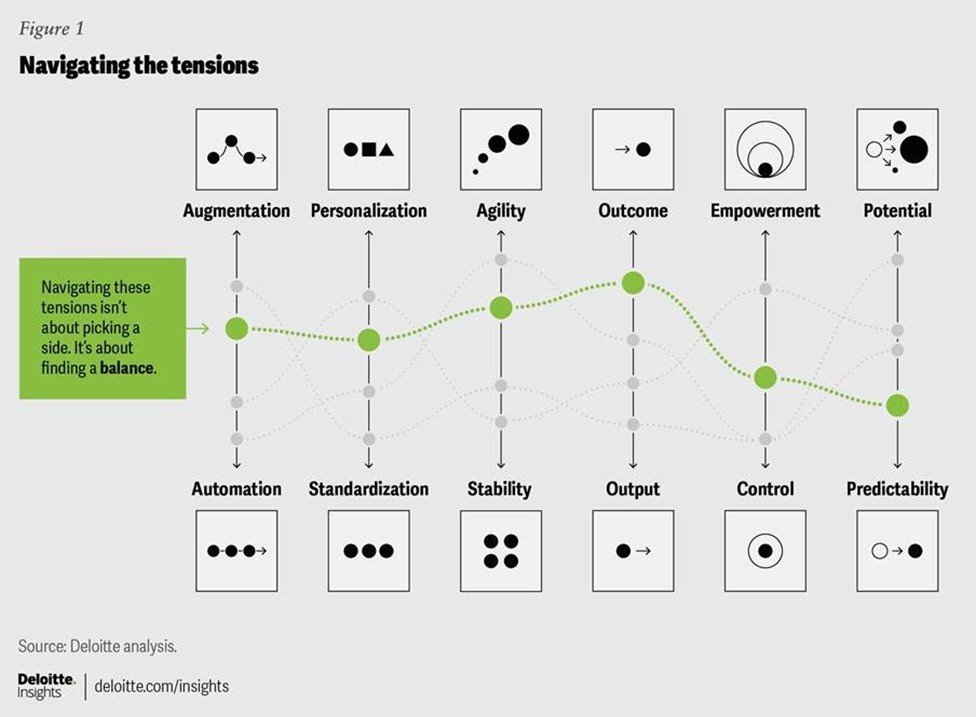
The report also highlights a tension between what workers need — like stability and clear expectations — and what businesses require — agility and transformation. To address this, Deloitte introduces the term “stagility,” which suggests finding a middle ground between being stable and being agile.
When it comes to the workforce, there’s a notable gap where companies often can’t find qualified candidates, while potential workers struggle to get the experience they need. This issue is made worse by the influence of AI on entry-level positions, a decline in apprenticeships, and an increase in job complexities.
On the organization and culture front, the report questions traditional performance management. Instead of annual reviews, there’s a growing emphasis on everyday feedback and clarity. The low trust in these traditional systems shows it’s time to rethink how we foster performance in our daily work lives.
Key Takeaways for Communicators
For communication professionals, this report is particularly relevant because it positions communication as a core enabler of performance rather than a supporting activity. Deloitte consistently points to the quality of the worker–organization relationship as a determining factor in whether organizations can navigate uncertainty and sustain momentum. That relationship is shaped, strengthened, or weakened through everyday communication.
A central message for communicators is the need to help leaders move away from binary thinking. The report shows that many organizational tensions are framed as either-or choices, such as stability versus agility, human outcomes versus business results, or automation versus reinvention. Communication plays a critical role in helping leaders explain these tensions honestly, articulate trade-offs, and shows how balance will be achieved over time. When these tensions are left unspoken, they become sources of confusion, resistance, and mistrust.
The report gives communicators strong evidence to tackle overload and low-value work. By naming excessive meetings, inefficient processes, and digital noise as barriers to performance, Deloitte provides a credible platform for communication-led simplification efforts. Communicators can support leaders in prioritizing what matters, reducing unnecessary communication, and creating space for focus, reflection, and meaningful work.
The concept of stagility offers a useful framing for change communication. Workers are seeking stability, while organizations are pushing for agility. Without clear anchors, constant change quickly becomes exhausting. Communicators can help create those anchors by reinforcing shared purpose, clarifying what is not changing, and building a consistent narrative that helps people understand how work is evolving and why.
The report also reframes talent challenges in ways that are highly relevant to communication. The experience gap is not only a hiring or development issue, but a communication issue. When organizations raise experience requirements or rely heavily on AI for entry-level work, people can feel excluded or undervalued. Communicators can help make development pathways visible, explain how experience will be built, and shape leader messaging that is fair, realistic, and motivating, rather than implicitly blaming individuals for systemic constraints.
Trust in performance management emerges as another key communication challenge. Deloitte makes it clear that performance is driven less by formal processes and more by everyday clarity, coaching, and feedback. Low trust in performance systems points to inconsistent messages, unclear expectations, and weak feedback loops. Communicators can support leaders and managers by strengthening line-of-sight communication, reinforcing shared standards, and encouraging feedback-rich environments in daily work, not just during review cycles.
Finally, while is AI featured prominently throughout the report, Deloitte’s emphasis is firmly on the human experience of working alongside technology. The implications for communicators are significant. People need clear, honest communication about how AI will affect their roles, what support is available, how learning will happen, and where human judgment and agency remain essential. Communication that centers on fairness, transparency, and care will be critical to maintaining trust and motivation as AI reshapes work.
This report reinforces that effective communication is not about volume or polish. It is about clarity, consistency, and credibility in moments of uncertainty. For communicators, this positions the function as a strategic partner in enabling performance, trust, and long-term value.
Access the Report
The Ipsos Reputation Council Report 2025: The Eye of the Storm
Source: Ipsos
Submitted by: Daniella Girgenti
A Glance at the Report
The Reputation Council Report 2025 from Ipsos captures how the role of chief communications officer (CCO) has fundamentally shifted in an era of persistent polycrisis, where geopolitical instability, societal polarization, and rapid technological change overlap rather than occur in neat sequence.
Based on in-depth interviews with 161 senior communications leaders across 19 global markets, the report argues that CCOs are no longer primarily message stewards but strategic sense-makers for their organizations. In this environment of constant turbulence, organizations are becoming more selective about when they speak publicly, more pragmatic about ESG, and more cautious about the adoption of AI, while simultaneously relying more heavily on communications leaders as trusted advisors to CEOs and boards.
Key Takeaways for Communicators
A central finding for communicators is the rise of what Ipsos calls “strategic silence.” Only a minority of leaders now believe organizations should routinely speak out on divisive societal or political issues. Instead, most decisions are situational and grounded in risk assessment, materiality, and authenticity. This reflects a world in which corporate statements can trigger backlash across markets and stakeholder groups. For communicators, the implication is clear: judgment matters more than visibility. Internal communications, culture-building, and consistency between values and operations have become as reputationally significant as external messaging, if not more so.
The report also highlights a pragmatic recalibration of ESG and AI. While public ESG rhetoric is being dialed back due to politicization and credibility concerns, the underlying principles are becoming more deeply embedded in business strategy, operations, and risk management. Communicators are being pushed to move away from broad labels and toward precise, evidence-based explanations of what their organizations are actually doing and why it matters. Similarly, although AI is widely used, confidence in its meaningful application has declined, underscoring the need for ethical guardrails, transparency, and human oversight.
Across all themes, the report reinforces that today’s communicators must operate as cross-functional strategists, fluent in geopolitics, regulation, technology, and stakeholder insight, and have the ability to translate external volatility into clear guidance for leadership.
Access the Report
The State of AI: How Organizations Are Rewiring To Capture Value
Source: McKinsey
Submitted by: Joe Bobbey
A Glance at the Report
Organizations are beginning to create structures and processes that lead to meaningful value from generative AI, including redesigned workflows, elevated governance, and more mitigation of risks.
“Organizations are starting to make organizational changes designed to generate future value from [generative] AI, and large companies are leading the way,” reported McKinsey & Company in early 2025, following a survey of nearly 1,500 participants in July 2024. A majority of respondents also said they are seeing meaningful cost reductions within business units from use of generative AI. Yet the effects on the enterprise-wide bottom line aren't yet material.
Key Takeaways for Communicators
Responses indicated an increase in individual use of generative AI, with the highest percentage among C-level executives. Most use of the technology was reported in IT and marketing and sales functions, followed by service operations. Of all respondents, most said their organizations are creating text outputs with generative AI, followed next by generating images, then by creating computer code.
Many organizations are also reported to be increasing efforts to address related risks, including inaccuracy, cybersecurity, and intellectual property infringement. Twenty-seven percent of respondents whose organizations use generative AI say that employees review all content created before it is used. A similar share says that 20% or less of generative AI-produced content is checked before use.
Access the Report
Reputation, Risk, and Resilience: Where Are We Now and What Happens Next?
Source: Rod Cartwright Consulting
Submitted by: Denise Caesar
A Glance at the Report
In this report, Rod Cartwright presents a clear-eyed and highly practical assessment of the risk landscape confronting organizations. He argues that leaders are now operating in an era of permacrisis, a condition marked by persistent, interconnected, and intensifying threats rather than discrete, one-off events.
Cartwright identifies 10 converging risk themes shaping this environment, including geopolitical volatility, climate emergency, economic fragility, mental health and disengagement, polarization and disinformation, cyber insecurity and AI, widening inequality, and demographic tensions. These are framed through three critical risk dynamics: steady-state risks that have become dangerously normalized, “sleeping giant” risks hidden in organizational blind spots, and risk accelerators that are deeply interconnected and fundamentally human.
Key Takeaways for Communicators
Cartwright positions crisis leadership as a sensemaking discipline, challenging communicators to move beyond reactive messaging and instead function as strategic navigators who can interpret complexity, connect weak signals across systems, and anticipate escalation. He stresses that effective crisis management cannot remain theoretical or policy-driven; it must be operationalized in real time. Central to this is empathy, which he reframes not as a soft value but as a critical capability that must be deliberately embedded into leadership behaviour, decision-making, and communications under pressure.
The report challenges organizations to rethink crisis through practical lenses, from properly defining crisis and shifting focus from “the self” to “the other”; to embedding character, culture, linguistic precision, and cross-functional readiness; and reframing reputation as a relationship asset rather than a defensive shield. A core recommendation is the use of realistic stress tests and simulations to expose gaps between perceived readiness and actual performance under ambiguity, time pressure and public scrutiny.
Ultimately, Cartwright positions the modern chief communications officer as a sensemaker-in-chief, responsible for operationalizing empathy, prioritizing relationships over systems, and recognizing that in today’s fused risk environment, trust is sustained by actions.
Access the Report
ICCO World PR Report 2024-2025
Source: International Communications Consultancy Organisation (ICCO)
Submitted by: Jacob R. Robinson
A Glance at the Report
Beyond technological and economic shifts, the PR industry urgently needs to attract and retain top talent to remain competitive. Findings from ICCO’s annual report show that younger professionals are drawn to purpose-driven careers, making diversity, inclusion, and ethical leadership critical for long-term success. However, recent corporate retrenchment from diversity, equity, and inclusion (DEI) initiatives from some signals a concerning shift in priorities and values. This makes it even more essential for the PR industry to champion transparency and aspirational appeal, resisting complacency and self-serving behavior. It’s a delicate balance: How will you embrace innovation strategically, while also staying true to the core tenets of goodwill, trust, and ethical communication?
Firms in the report were most likely to identify corporate reputation and strategic consulting as their most significant sources of growth, and the areas where the most growth is expected in the future, as called out by contributors Grzegorz Szczepański, CEO of Burson Poland, Paul Holmes, founder and editor of PRovoke Media, and James Endersby, CEO of Opinium.
It’s no longer good enough to be good at what you do. That’s the individual equivalent of the dreaded “we’ve always done it this way.” We must go beyond comfort and simplicity to fight stagnation. What are the real problems and how are we solving them? How do our decisions align with business objectives? How is what we’re doing impacting society? What are the mechanisms in place to hold us to account? These are some of the deeper, provocative questions that start to get us going to where we’d like and need to be.
As the report mentions, the PR industry has always been about influence and storytelling. It humbly faces great modern challenges and pressures. But it also has the opportunities to match and stage its acta non verba long before pressure mounts. In our search for truth, principled leadership has never been more consequential and needed, no matter where you may be in the world. The report also draws on The Warsaw Principles for the Rule of Law, for guidance in a world where disorder is the default.
Key Takeaways for Communicators
With power comes responsibility: Efficiency gains, driven by AI or otherwise, must not come at the expense of the essentials: purpose, listening, trust, and transparency. People are watching closely. They are voting with their feet and their wallets. They are following not only the technological advancement, but how brands choose to act. And they see through empty rhetoric.
Will you be a force for good, or will you make the b-line for what's legally defensible? Will you invest in AI or invest in your workforce so they use AI more thoughtfully and sensibly? Tough times reveal true colors, as do ethical dilemmas. Brands that collectively commit to their ethos will openly and gladly take the time to fully understand how AI adoption makes sense for their enterprise and parlay this nuance into profitability, not the other way around.
Ethical brands are poised to usher in a new era ruled by dynamism and volatility, winning talent and business, and reputational currency; they understand that AI is meant to work with human-led intelligence, not replace it. Ethics therefore is not a tick-the-box exercise; it is a strategic capability in letter and spirit. Communication professionals must remain proactive and be prepared to take on the role of first responder when summoned to do so.
PR’s greatest challenge: The challenge of identifying and combatting misinformation is outranked by all others in the report, including lack of training, incentive, and internal policy, and even lack of consequences for agencies that do not behave ethically.
As communication professionals know, misinformation spreads alarmingly fast; far faster than good news. The growing sophistication of AI use exacerbates this issue, making it increasingly difficult for PR professionals to address reputational crises created by false narratives and polarizing algorithms. So the key to differentiation isn't solely in agility or adaptation. A world increasingly hit by a barrage of noise and uncertainty requires a steady, guided hand to successfully navigate the choppy waters. To expect the unexpected, to become the signal, to safeguard reputation. Communication professionals can look here to reframe their proposition and secure desired outcomes.
Regional attitudinal nuances vis-a-vis AI: North America leads in AI adoption but grapples with ethics and talent retention, while Europe emphasizes ESG, governance, and reputation management. Asia-Pacific is highly optimistic, driven by innovation and purpose-led growth. Latin America faces economic constraints but sees opportunity in digital PR and reputation-building, and Africa stands out as a high-growth market, particularly in social media, influencer marketing, and ESG communications.
Agencies based in North America appear to be leading the AI race as it stands: 100% of respondents from this geography say AI tools are now integrated into their everyday tasks (compared to 69% in the UK and Asia). To what end remains to be seen, but the ripple effects of the velocity are undeniable and profoundly felt.
War for talent: Broadening the pool of talent to include other fields and professions not traditionally associated with PR promises to yield significant gains for the industry as a whole. The grass is greener where we water it. Having and maintaining literacy in other industries, complementary and dissimilar, helps us advance the art and science of connection, how to capture minds and hearts beyond our own. Building our talent pool calls for changing not only how we work, but how and where we find the people that make up our workforce. This is an essential step to assure continuity, and to help in the advocacy and the advancement of our profession.
Access the Report