When was the last time you saw authentic disability representation in your brand’s marketing? I ask that question often — of brands I buy from, of communication professionals, and of myself.
Despite the fact that 1.3 billion disabled people worldwide control an estimated US$18 trillion in annual spending power, disability remains dramatically underrepresented in marketing. Just 1% of advertising spend features disability, and 98% of disabled consumers say media and marketing fail to reflect their lived reality.
As communication professionals, this is more than a missed market opportunity. It’s a credibility gap. We work hard to craft purpose-led narratives. We counsel leaders on authenticity. We build brands around values. Yet when disability is largely invisible in our communications, the gap between what we say and what we show becomes impossible to ignore.
From Intention to Execution
In my experience, most organizations genuinely want to do better. The issue isn’t intent. It’s execution. Too often, disability inclusion has been siloed within HR or diversity functions, disconnected from the marketing and communications teams who shape public narratives every day. Creative teams lack a shared language. Leaders lack benchmarks. Communications professionals lack a practical, structured pathway to improve representation.
That is precisely why I believe the Authentic Representation Tool (ART), developed by Valuable 500, is such an important step forward.
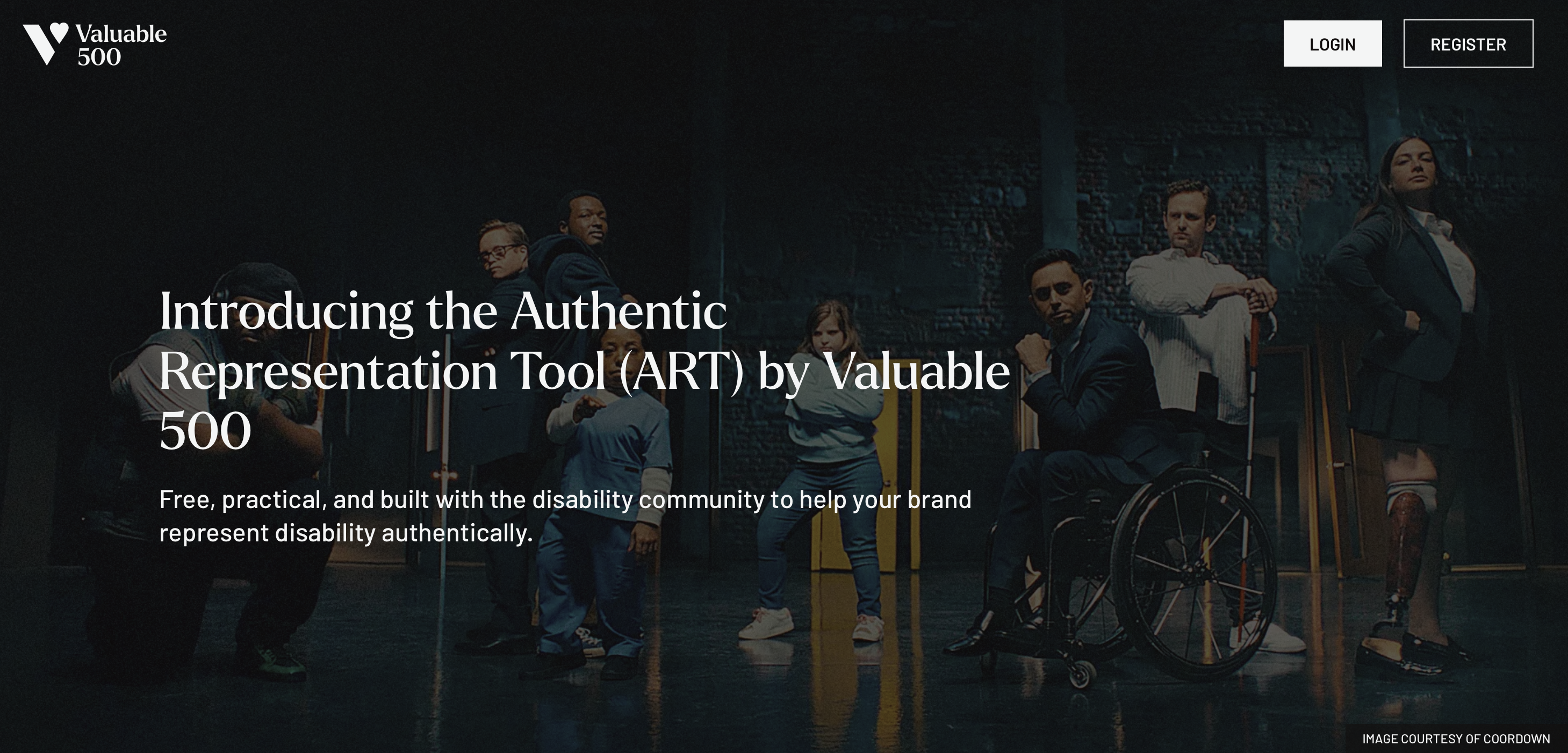
Valuable 500 homepage banner promoting the Authentic Representation Tool (ART), featuring a diverse group of disabled people posed confidently in a dark studio setting. Text highlights ART as a free tool built with the disability community to help brands represent disability authentically. Login and Register buttons appear in the top right.
What ART Actually Does
ART is a free, confidential self-assessment framework designed specifically for marketing and communications teams. Designed as a gap analysis tool, it shows where your organization sits across detailed levels of maturity in all aspects of disability representation and accessibility. This includes, for example, universal design in product and content development, accessibility, and disability in imagery/content.
ART was developed collaboratively with disability experts, global brands, and leading creative agencies to ensure it is both credible and practical. Rather than offering abstract principles, ART translates inclusion into actionable business practice across three core pillars.
Accessible Experiences
Are you removing barriers across every brand touchpoint — digital, physical, experiential? Accessibility is not an afterthought; it is the foundation that enables participation and belonging.
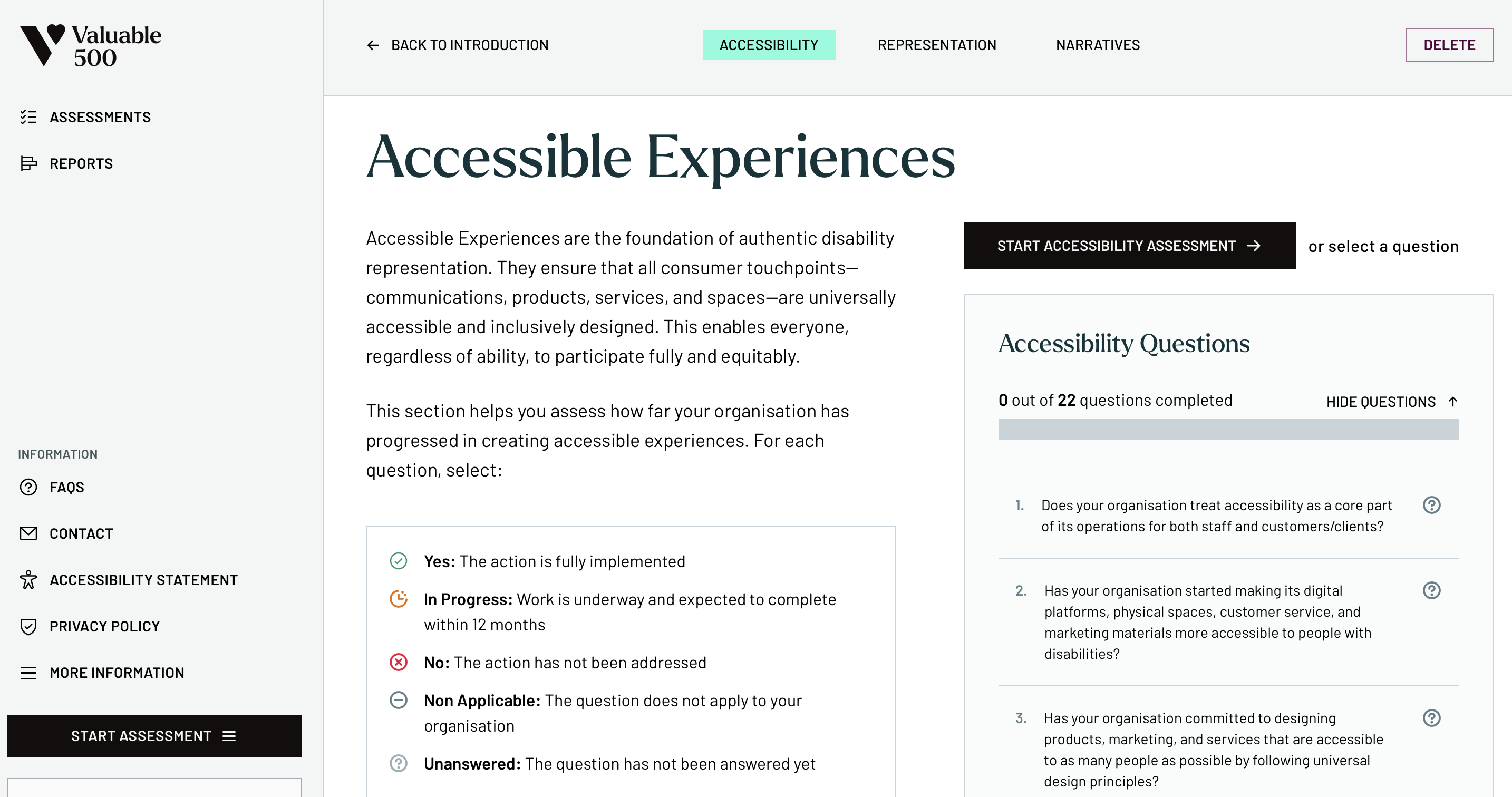
Valuable 500 assessment dashboard page for “Accessible Experiences,” explaining accessibility as the foundation of authentic disability representation and showing 22 accessibility assessment questions with progress tracking.
Accurate Representation
Are disabled people visible in your marketing in ways that reflect reality, including visible and invisible disabilities and intersectional identities? This goes beyond token inclusion toward consistent, normalized presence.
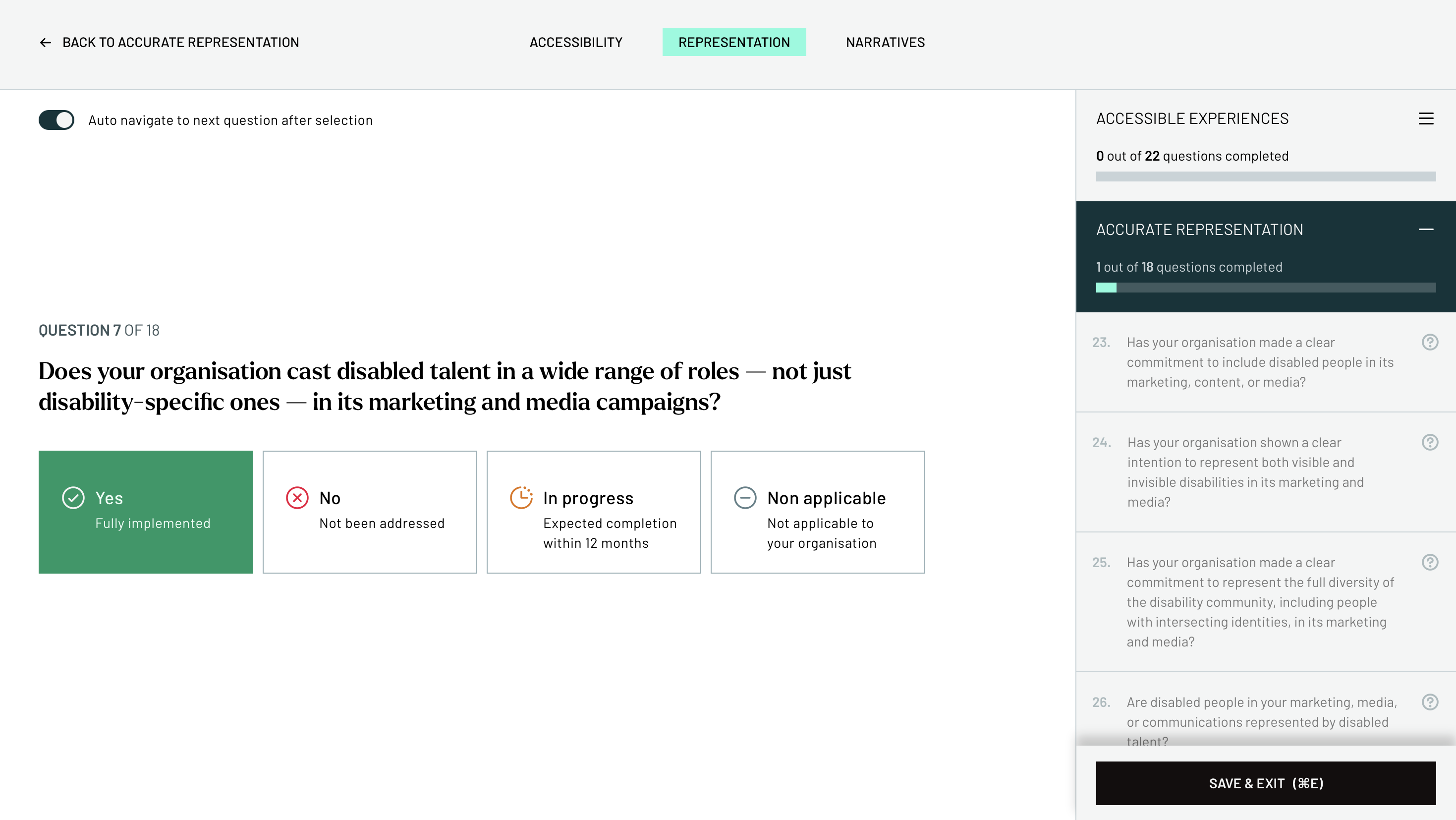
The Valuable 500 assessment question in the “Representation” section asks whether an organization casts disabled talent in a wide range of roles in marketing and media, with “Yes” selected and progress shown for the Accurate Representation category.
Authentic Narratives
Are disabled voices shaping the stories you tell? Moving beyond stereotypes and inspiration tropes toward narratives grounded in lived experience changes not only perception, but cultural relevance.
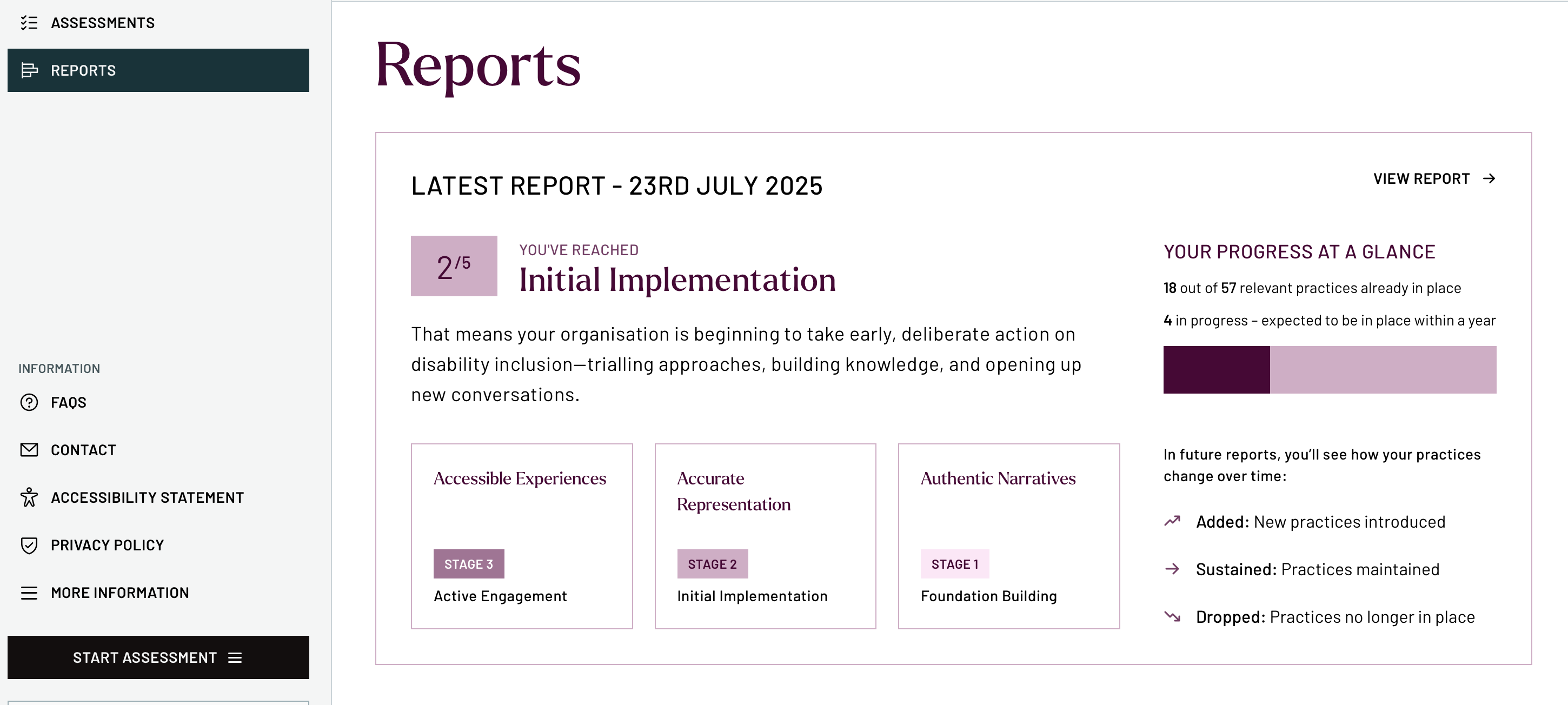
Valuable 500 Reports dashboard showing an organisation’s disability inclusion progress at Stage 2, “Initial Implementation,” with category breakdowns across Accessible Experiences, Accurate Representation, and Authentic Narratives.
A Tool Tailored to Marketers and Communicators
What makes ART different is that it speaks the language of marketers. It provides tailored priority actions, practical implementation resources, and curated expert connections. It recognizes that representation is shaped by creative processes, agency briefs, procurement decisions, and measurement frameworks — not just policy statements.
Kearney was proud to play a key role in supporting the development of ART. Our involvement stemmed from a simple belief: systemic change in disability representation requires changes in business systems — not just individual campaigns. If we want representation to improve globally, we need structured tools that embed inclusion into how organizations plan, create, approve, and measure communications.
ART provides that structure.
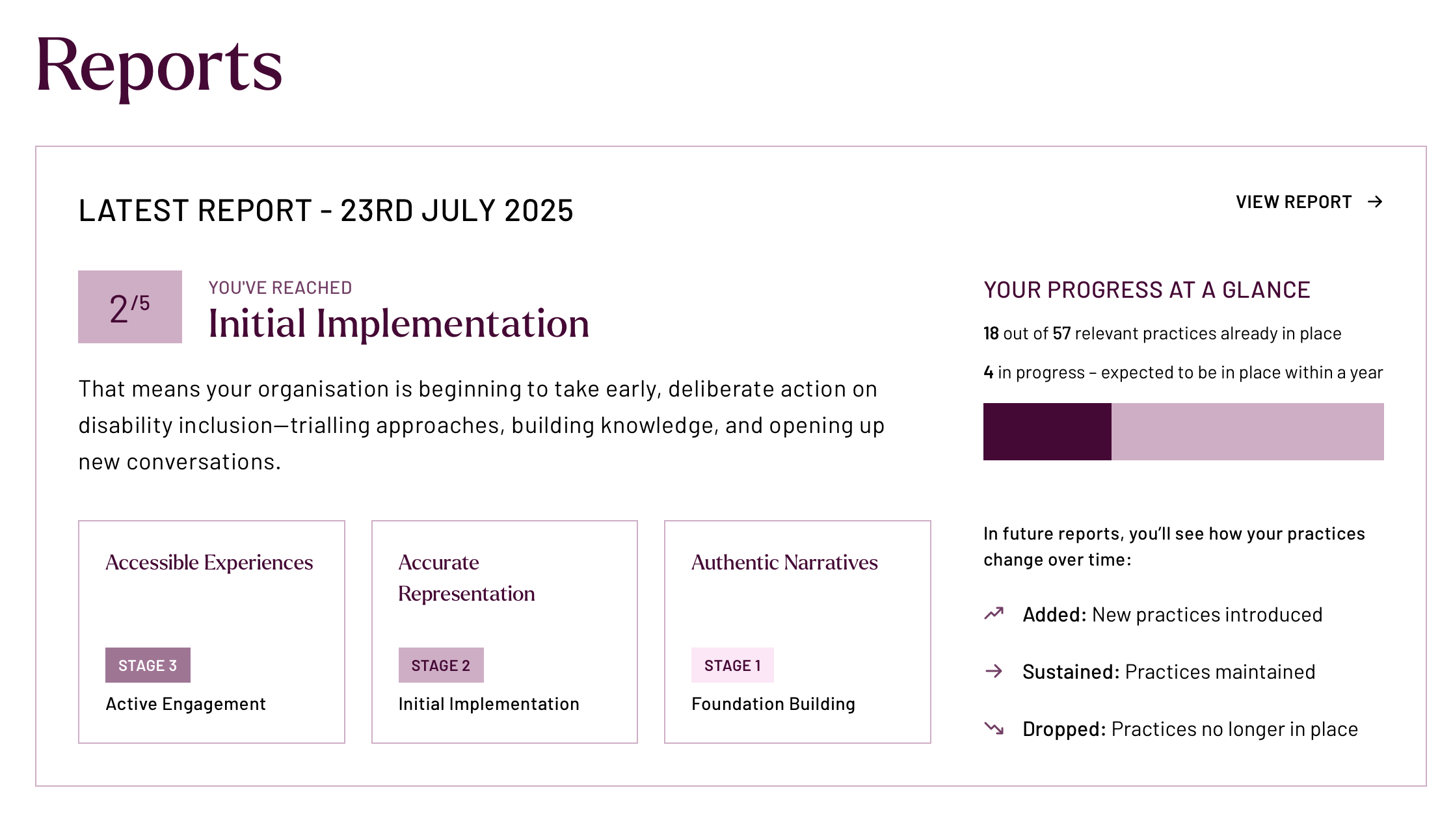
Valuable 500 latest report summary dated 23rd July 2025, showing Stage 2 “Initial Implementation,” overall disability inclusion progress, and category scores across three assessment pillars.
Why This Matters, Commercially and Professionally
The business case is compelling: 54% of disabled consumers are more likely to purchase from companies that authentically represent disability. But in my view, the opportunity is bigger than revenue. It is about relevance.
As communicators, we are custodians of brand trust. Audiences increasingly expect alignment between stated values and visible behavior. Disability inclusion is no longer a peripheral issue — it is a litmus test for whether brands truly understand the societies they serve.
Through my work at Kearney, I have seen how embedding inclusion into core business systems drives more sustainable outcomes than one-off campaigns. When representation becomes part of how organizations plan strategy, allocate budgets, and evaluate creative work, it shifts from reactive to intentional.
Using ART can make that shift practical for you.
The Role of Communication Professionals
As an IABC Fellow, I believe our profession has a unique responsibility here. We are not just content creators. We are narrative architects. We influence what is normalized, who is visible, and whose voices are amplified. If disability continues to be overlooked in mainstream communications, it is not simply a societal oversight, it is a professional one.
ART gives communication professionals a concrete way to lead rather than wait. The assessment takes around 30 minutes to complete. In return, teams receive a customized roadmap outlining priority actions, implementation resources, and expert guidance.
Crucially, it is not designed as a one-off audit. It is intended to be revisited as organizations evolve, reflecting the reality that authentic representation is not a destination, but a continuous commitment.
From Commitment to Action
Many organizations have already made public commitments to diversity and inclusion. The question now is how we translate those commitments into visible, measurable change.
For me, ART represents a practical bridge between aspiration and action. It moves disability inclusion out of abstract discussion and into the daily decisions that shape campaigns, content, and customer experiences. If we want disability representation to change globally, communications professionals must be part of that change.
I encourage you to explore the Authentic Representation Tool at art.thevaluable500.com and consider how your organization might use it. Thirty minutes of reflection can be the starting point for genuine transformation.
Because authentic representation doesn’t happen by accident. It happens when we choose to make it part of how we work.